
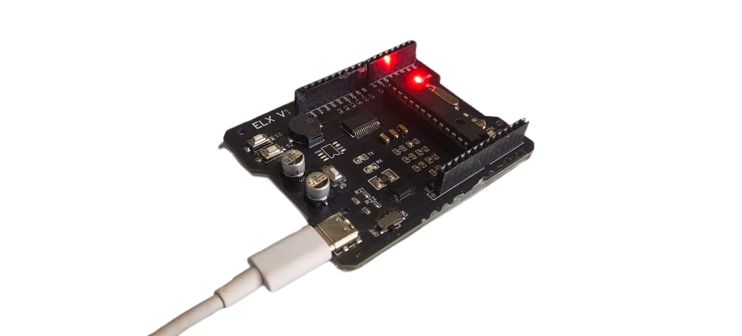

ELX V1: India’s Own Next-Generation Arduino-Compatible Microcontroller Development Board
Introduction
Electronics has become the backbone of modern innovation. From smart homes to industrial automation, robotics to healthcare devices, every project begins with one crucial piece of hardware: the microcontroller development board. For decades, popular boards like Arduino Uno, Nano, or Mega have dominated the global DIY and prototyping landscape. However, most of these solutions have originated outside India, leaving local developers dependent on imported products with limited customization.
Enter ELX V1 – a self-developed microcontroller development board proudly “Made in India”. Designed with a vision to elevate the prototyping ecosystem, ELX V1 doesn’t just mimic the features of conventional boards; it redefines them. While fully Arduino-compatible, ELX V1 introduces distinct innovations such as status LEDs on every GPIO pin, an onboard buzzer, an improved FTDI-based programmer, and premium-grade specifications that make it stand apart from its competitors.
This article will take a deep dive into ELX V1, its origin, its distinctiveness, the philosophy behind its creation, and why it represents a milestone in India’s journey toward hardware self-reliance.
The Origin Story: Why ELX V1?
The idea of ELX V1 was born out of frustration and vision. For years, Indian makers, students, and innovators have relied on imported boards. While Arduino and its clones made prototyping accessible, they often left much to be desired in terms of usability, debugging, and premium build quality.
Three pain points stood out for the team behind ELX V1:
- Debugging GPIOs is a hassle. On conventional boards, there’s no immediate visual way to check whether a pin is HIGH or LOW without wiring an external LED.
- Lack of onboard signaling. Simple features like buzzers are often missing, requiring additional circuitry for feedback in projects.
- Programmer quality. Many low-cost boards rely on subpar USB-to-serial converters, leading to unstable programming or poor reliability in long-term use.
Thus, ELX V1 was envisioned as a microcontroller development board built for Indian innovators, combining robustness, usability, and modern features while still remaining Arduino IDE compatible.
Key Features that Define ELX V1
1. Status LED on Every GPIO Pin
This is perhaps the most game-changing innovation in ELX V1. Every GPIO pin comes with its own dedicated status LED.
- No more fiddling with jumper wires just to check pin states.
- During debugging, a quick glance at the board instantly reveals which pins are active.
- For education and training, beginners find it much easier to understand digital logic visually.
In short, this feature transforms how one interacts with microcontroller pins—making prototyping smoother, faster, and more intuitive.
2. Onboard Buzzer for Instant Feedback
Another thoughtful addition is the onboard buzzer.
- Developers can immediately integrate audio feedback into their projects without attaching external modules.
- Perfect for signaling, alarms, or debugging.
- Enhances interactivity in robotics and IoT projects where sound alerts are critical.
This single addition eliminates the hassle of wiring a buzzer circuit every time a project requires audio indication.
3. Improved FTDI-Based Programmer
Unlike many low-cost Arduino clones that use unreliable CH340 chips, ELX V1 employs an improved FTDI-based USB-to-Serial programmer.
- Provides stable and faster communication between PC and board.
- Works seamlessly across Windows, Linux, and macOS without driver headaches.
- Supports higher reliability in professional use cases.
This single design choice ensures that ELX V1 is not just a beginner’s toy but also a professional-grade tool.
4. Premium Build Quality and Specs
The ELX V1 board is not an afterthought or a cheap clone. It is designed to deliver premium specifications that outshine its competitors.
- High-quality PCB with superior copper thickness for better current handling.
- Carefully chosen components with longer lifespan and stable performance.
- Compact yet ergonomic design ensuring easy wiring and modular expansion.
- Gold-plated headers for improved durability and connectivity.
This makes the board reliable not only for classrooms and hobbyists but also for industrial prototyping and serious research projects.
5. Made in India – For India and Beyond
A crucial pride factor for ELX V1 is that it is designed, engineered, and manufactured in India.
- This contributes to India’s vision of becoming a global hub for electronics innovation.
- Reduces dependency on imported boards.
- Encourages local ecosystem development, training, and entrepreneurship.
It is more than a product—it is a statement of self-reliance and innovation.
Future Roadmap
While ELX V1 is a strong foundation, the journey doesn’t end here. Future versions may include:
- WiFi and Bluetooth-enabled variants.
- Extended onboard memory and faster microcontrollers.
- Modular expansion shields for IoT, AI, and robotics.
- Integration with cloud-based debugging tools.
The team envisions creating a family of ELX boards that can stand toe-to-toe with global giants.
Conclusion
The ELX V1 microcontroller development board is more than just another Arduino-compatible device. It is a statement of innovation, quality, and national pride. By addressing the long-standing pain points of conventional boards, it delivers a premium experience through features like GPIO status LEDs, an onboard buzzer, and an improved FTDI-based programmer.
Proudly Made in India, ELX V1 represents a leap forward for the maker community, students, and professionals alike. Whether you are debugging a simple LED blinking code, building an IoT prototype, or creating a robotics project, ELX V1 makes the process smoother, faster, and more reliable.
In a world dominated by imported hardware, ELX V1 shines as India’s own contribution to global prototyping tools, setting a high benchmark for future innovation.
